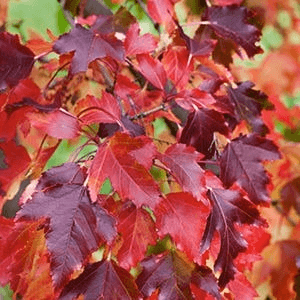
This tree has a graceful, irregular shape formed by slender spreading branches. Extremely hardy, it is an excellent xeriscape plant, and offers outstanding fall color. Amur Maple does not store well over winter. In order to insure viability of plants, these trees are dug in spring, resulting in a later shipping date than our fall dug trees.

Amur maple is a small tree that can grow up to 20 feet tall with a broad crown. However, it sometimes is seen as a pruned hedge. Tatarian maple can grow up to 30 feet tall. Leaves are arranged opposite each other on smooth, lightly colored twigs. Amur maple leaves are longer than wide (1-3 inches long) and have double-toothed edges.
Leaves have three lobes, with the middle lobe longer than the other two lobes. They turn a brilliant red in autumn. Compared to Amur maple, Tatarian maple leaves can be more rounded with less distinct lobes and the leaves can be less shiny. Amur and Tatarian maple bark is smooth and gray, becoming gray-brown with age. It readily resprouts when cut, so can often be found in both multi-stemmed or single-trunk form.
Look-alikes
Red maple
Acer rubrum (native)
The middle lobe in Amur maple tends to be more elongated than that of red maple. Amur maple flowers are yellow-white and fragrant, while red maple flowers are reddish and not scented. The fruits of Amur maple hang on the tree into late fall, while red maple drops its seeds much earlier.
Amur maple and Tatarian maples are deciduous trees. Amur maple can reach heights of 20 feet and Tatarian maple can reach 30 feet. They are tolerant of a wide range of soils, but grow best in moist, well-drained soils. The are tolerant of shade and are often found in disturbed areas, along forest edges, roadsides, in early successional forests and in ornamental landscapes.